
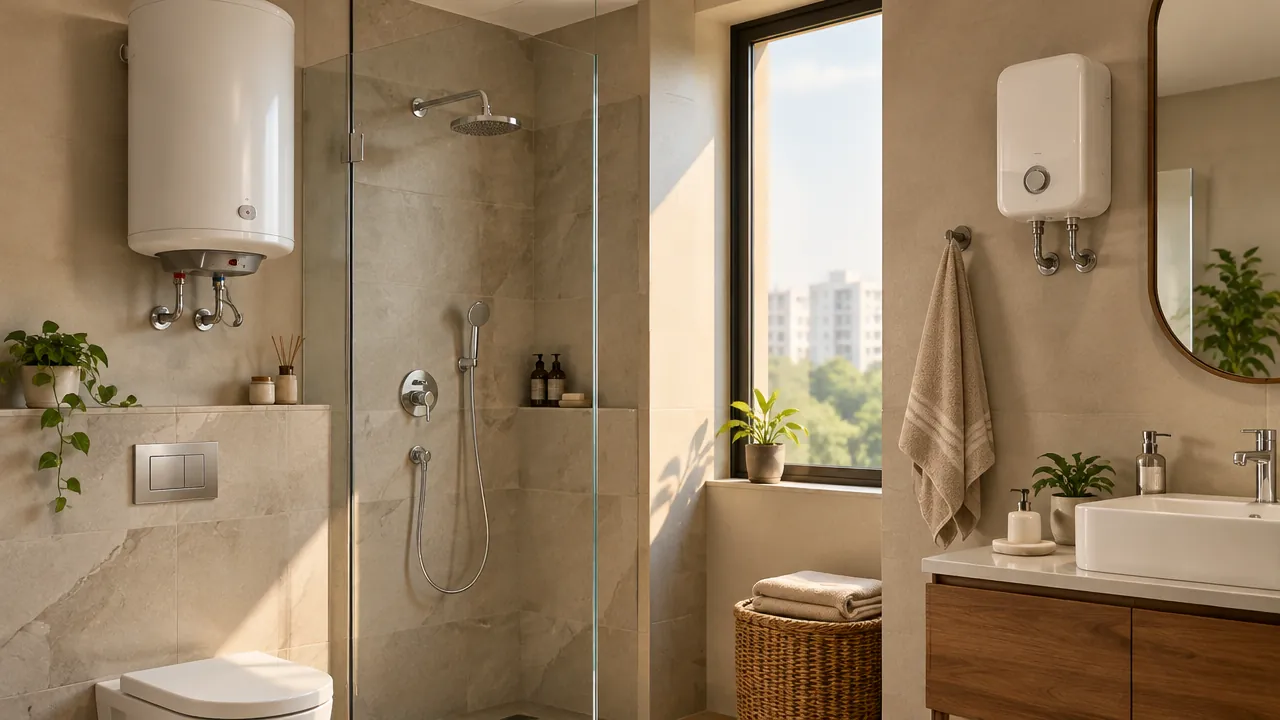
The right water heater for home India households depends on where hot water is needed, how much is used at a time and when people need it. Storage geysers hold heated water in a tank, while instant models heat water as it flows through the unit. Neither is automatically cheaper or better for every home.
Use your bathing routine, household size, available electrical capacity and water quality to decide. In some homes, the practical answer may be a storage model for the bathroom and a compact instant geyser for the kitchen.
How storage and instant geysers differ
Storage models keep hot water ready in a tank
A storage geyser heats a tank of water and keeps it available for use. Its capacity is measured in litres. This makes it a common choice for showers or bathing when several people need hot water, though the amount available at once is limited by the tank size and how quickly it reheats.
Because water stays hot in the tank, some heat escapes over time. The heater may need to run again to maintain its temperature, even if nobody is using water.
Instant models heat water on demand
An instant geyser heats water as it passes through the unit. It has no large storage tank, so it can work well for a sink or washbasin where a modest amount of hot water is needed. Many compact models are around 1-3 litres, but check the product’s flow rate and intended use rather than relying on tank size alone.
Instant units can have a high power rating while operating. Confirm that your home’s wiring, circuit and power supply can support the model. A qualified installer can check this before installation.
Choose capacity based on household size and usage
Match storage capacity to bathing needs
As a starting point, a 15-litre storage water heater may suit one or two people, while a 25-litre model may be more suitable for a family of four. These are broad guides, not fixed rules. The right size also depends on whether people take showers or use buckets, how long showers last, and whether bathing happens one person after another.
Consider the timing between users, too. If the tank is emptied quickly, the next person may have to wait for reheating. A larger tank can provide more hot water at once, but it also takes more space and may use more energy to heat. Avoid choosing extra capacity without a clear need.
Consider compact instant models for kitchens and washbasins
A 1-3 litre instant geyser may suit tasks such as washing dishes or using a washbasin, where hot water is needed briefly and close to the outlet. For bathing, check whether the model is designed to deliver enough hot water at the required flow rate. A small instant unit may not provide the continuous flow or temperature you expect for a shower.
Pick the type that fits each room and routine
Choose by point of use, not just by household headcount. A bathroom used for consecutive baths usually benefits from the ready supply of a storage tank. A kitchen sink used intermittently may be better served by a compact instant model, which avoids heating a large tank for occasional use.
Think about the distance between the heater and tap. A long pipe run can mean waiting for hot water and wasting some water before it arrives. Also check the space available, water pressure requirements and whether the chosen unit is suitable for the installation location. If hot water is needed at multiple outlets at the same time, confirm that the model and plumbing can handle that demand.
Compare electricity use, BEE ratings and running costs
A storage heater can lose heat while water sits in its tank, so its running cost depends partly on how long it stays hot and how often it is used. An instant model avoids tank standby loss, but it draws power while heating water. Your bill depends on usage, the unit’s efficiency, water temperature and local electricity rates - so “instant” does not automatically mean lower bills.
Reduce standby heat loss with practical usage habits
For a storage geyser, switch it on shortly before the water is needed and turn it off when it is ready, if that suits your routine and the product instructions. Avoid leaving it on all day without a reason. Use a sensible temperature setting; very high settings can increase energy use and the risk of scalding. Follow the manufacturer’s instructions for safe operation.
Check the Bureau of Energy Efficiency (BEE) label when comparing models. Compare the star rating of similar products with similar capacities, and check the label’s applicable period and energy-consumption information. A higher-rated model can be more efficient under the conditions covered by its rating, but it may cost more upfront. Consider both purchase price and expected use rather than choosing by stars alone.
Check hard-water protection and storage-tank durability
In hard-water areas, mineral deposits can build up on heating elements and inside tanks. Over time, this may affect heating performance and increase maintenance needs. Before buying, look for details on the inner-tank material, corrosion-resistant coating and heating-element protection. Some models include features intended to help with hard water, but confirm what the warranty covers and whether it specifies water-quality limits.
Ask about the recommended maintenance schedule, including inspection or replacement of protective components where applicable. Regular servicing can help identify scale or corrosion early. Have the unit installed as directed, and do not assume a hard-water feature removes the need for maintenance.
Use this checklist to make your final choice
Before buying, check:
- Household size and routine: How many people need hot water, and do they use it one after another?
- Location and task: Is the heater for bathing, a kitchen sink or a washbasin?
- Capacity and flow: Does the storage tank hold enough for your routine, or can an instant model deliver the flow you need?
- Energy use: Compare BEE labels and consider how often the heater will run.
- Water conditions: Check tank and element protection, warranty terms and maintenance requirements for hard water.
- Installation: Confirm space, plumbing, pressure compatibility and electrical load with a qualified installer.
Compare models using the capacity, BEE rating, hard-water protection and installation requirements that suit your home. Then choose the type that matches your daily hot-water routine.